
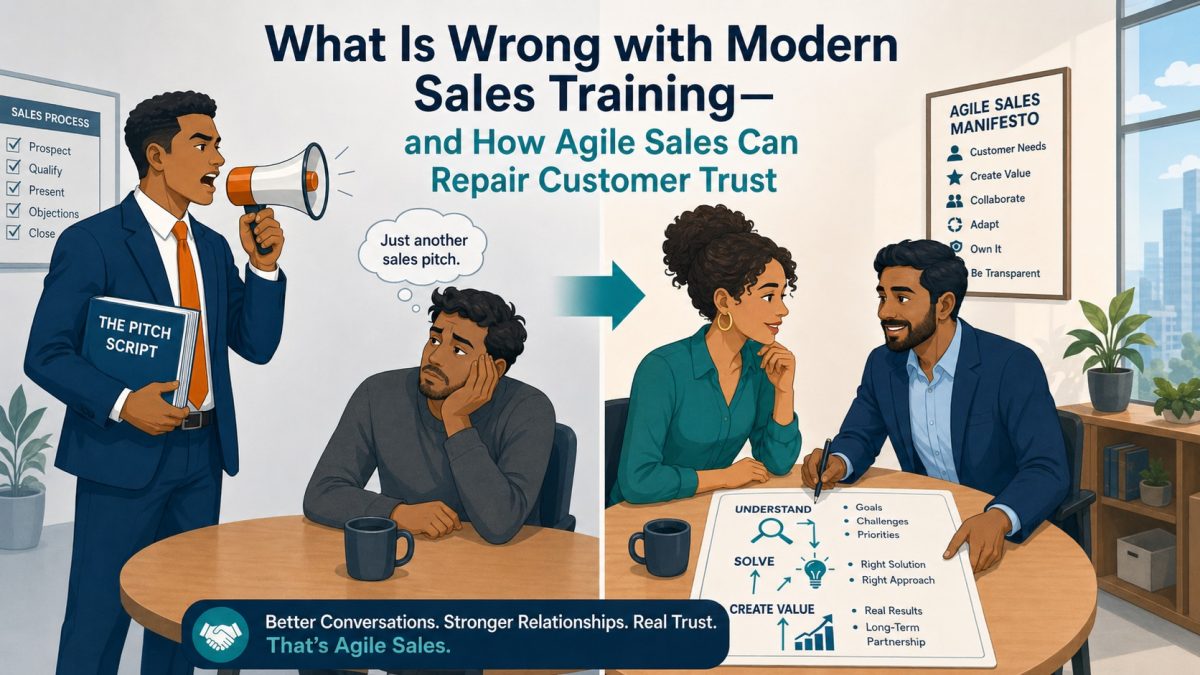
Author Note by Professor Thomas Hormaza Dow: Five Years ago I created the Agile Sales Manifesto with Christophe Martinot. This is a Reflection over the State of Sales Training Today.
How Agile Sales can repair customer trust
A professional reading document for business leaders, sales managers, and business students
| Central argument Much of modern sales training weakens customer trust when it teaches salespeople to manage, persuade, and move customers through a process instead of helping customers make better decisions. The Agile Sales Manifesto offers a better model because it reconnects sales with customer needs, value creation, transparency, adaptability, and accountability. |
Modern sales training is not useless. At its best, it improves communication, confidence, discipline, pipeline organization, follow-up, and decision guidance. The problem is that many programs still carry an outdated assumption: the customer is someone to be moved through a process.
That assumption is increasingly harmful. Modern customers are informed, cautious, busy, and capable of checking claims quickly. They do not need more pressure. They need help making better decisions.
The Agile Sales Manifesto reframes sales as the discipline of creating value with customers. Its six values offer a practical trust-repair model for modern sales training.
| 1. Customer Needs First Understand the customer’s reality before presenting the solution. | 2. Create Value, Not Closure Make the close the result of usefulness, not pressure. | 3. Keep the Promise Connect sales with delivery through cross-functional collaboration. |
| 4. Adapt to the Customer Use process intelligently instead of forcing every customer into a script. | 5. Look Inward First Treat poor outcomes as learning signals before assigning blame. | 6. Clarity Builds Trust Explain costs, effort, limits, support, and tradeoffs clearly. |
The Problem with Sales
Modern sales training is not useless. At its best, it helps salespeople communicate clearly, organize opportunities, understand customer needs, manage follow-up, and guide decisions with professionalism. Good sales training can improve confidence, discipline, and business performance.
The problem is that much of modern sales training still carries an outdated assumption: the customer is someone to be moved through a process.
That assumption is increasingly harmful. Modern customers are informed, cautious, busy, and capable of checking claims quickly. They can compare alternatives, read reviews, research competitors, watch demonstrations, speak with peers, and identify exaggeration before ever speaking to a salesperson. They do not need more pressure. They need help making better decisions.
This is where much of modern sales training falls short. It often teaches salespeople how to qualify, persuade, handle objections, create urgency, and close, but it does not always teach them how to earn trust. It can produce salespeople who sound polished but do not create enough value. It can reward confidence without credibility, activity without usefulness, and closing without accountability.
The issue is not that salespeople should stop selling. Businesses need revenue. Salespeople need structure. Customers often need guidance. Persuasion has a legitimate place in business. The problem begins when persuasion becomes disconnected from customer value.
The Agile Sales Manifesto offers a better path. It reframes sales not as the art of pushing customers toward agreement, but as the discipline of creating value with customers.
| The six trust-repair values 1. Customer needs over “rinse and repeat” pitch process 2. Always be creating value over “Always Be Closing” 3. Cross-functional and iterative engagement with customers over contract negotiation 4. Adaptability over prescriptiveness 5. Courageous introspection and personal accountability over assigning blame 6. Transparency over secrecy |
1. From Pitching at Customers to Understanding Their Reality
Agile Sales Value: Customer needs over “rinse and repeat” pitch process
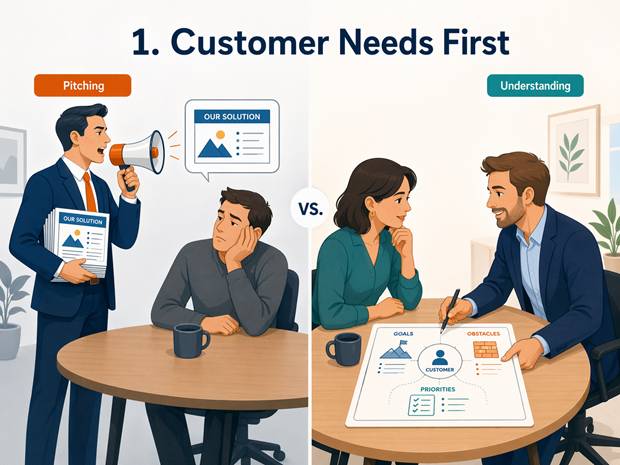
The salesperson earns the right to present a solution by first understanding the customer’s world.
| Trust-repair insight The salesperson earns the right to present a solution by first understanding the customer’s world. |
The first weakness in much of modern sales training is that it teaches salespeople to begin with the pitch.
The salesperson learns the product, the features, the benefits, the ideal customer profile, the objections, and the closing language. Then the customer conversation becomes an attempt to match the customer to the prepared message.
That may be efficient for the company, but it can feel empty to the customer. A repeatable pitch assumes that the seller already knows what matters. Agile Sales begins from a different assumption: value cannot be created until the customer’s reality is understood.
The customer is not a blank space waiting for the company’s message. The customer has existing pressures, constraints, disappointments, goals, risks, internal politics, budget realities, and previous experiences with other sellers. If the salesperson does not understand that reality, the pitch may sound professional but still miss the point.
For example, a salesperson selling a customer relationship management platform should not begin by presenting dashboards, automation features, integrations, and case studies. Those things may matter eventually, but they are not the starting point. The better starting point is understanding whether the customer has clean data, disciplined follow-up habits, a clear sales process, trained staff, and leadership support. Without those conditions, the platform may not create value. It may simply become another expensive tool that the customer does not fully use.
This is the first repair that Agile Sales brings to modern sales training. It teaches salespeople to diagnose before prescribing. It asks them to earn the right to present a solution by first understanding the customer’s world.
A pitch can create attention. Understanding creates trust.
2. From Closing Pressure to Value Creation
Agile Sales Value: Always be creating value over “Always Be Closing”
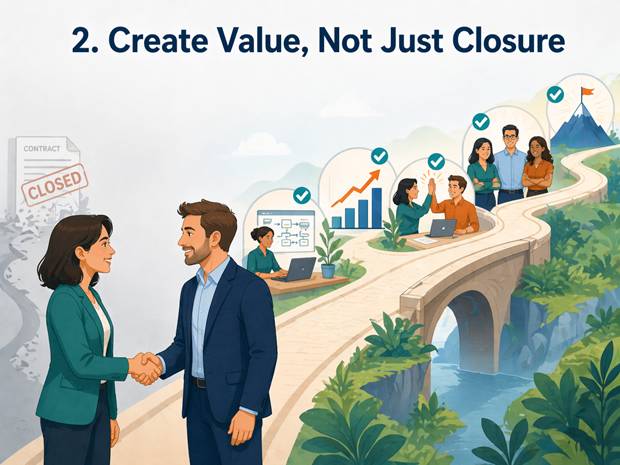
The close becomes stronger when it is earned through usefulness.
| Trust-repair insight The close becomes stronger when it is earned through usefulness. |
The second major weakness in modern sales training is the obsession with closing.
Salespeople are often trained to move the customer toward commitment, ask for the sale, create urgency, overcome hesitation, and secure the next step. These skills are not automatically wrong. A salesperson who cannot guide a decision is not doing the job well.
The problem begins when closing becomes the center of the sales conversation. When the salesperson is too focused on closing, customer hesitation is treated as resistance. But hesitation often contains useful information. A customer may hesitate because the value is unclear, the timing is poor, the implementation risk is high, the budget is uncertain, or the internal decision process is more complex than the salesperson realizes.
If the salesperson rushes to “handle” the objection, they may miss the truth inside it. This value does not reject the close. It puts the close in the right place. Closing should be the result of value creation, not a substitute for it.
For example, when a customer says that a solution is too expensive, weak sales training may teach the salesperson to reframe the price, defend the return on investment, or create urgency around the offer. Agile Sales asks the salesperson to go deeper. The price concern may mean that the customer does not yet see enough value, that the solution is too large for the current need, or that the salesperson has not connected the solution to a business outcome that matters.
In that situation, the salesperson creates value by clarifying the business case, adjusting the recommendation, explaining tradeoffs, or even acknowledging that the timing is not right. That is not passive selling. It is better selling.
3. From Winning the Contract to Keeping the Promise
Agile Sales Value: Cross-functional and iterative engagement with customers over contract negotiation
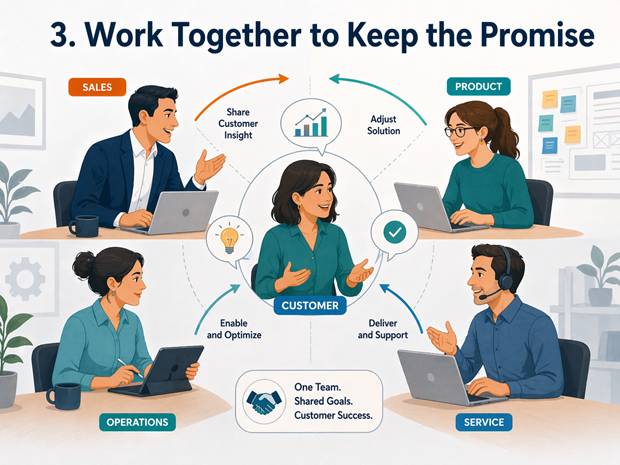
The contract may close the sale, but delivery proves the truth of the relationship.
| Trust-repair insight The contract may close the sale, but delivery proves the truth of the relationship. |
The third weakness in modern sales training is that it often treats the signed deal as the finish line. This is one of the most dangerous assumptions in sales.
A salesperson can win the contract and still damage trust if the organization cannot deliver what was promised. The customer does not experience sales, marketing, product, operations, service, and leadership as separate internal departments. The customer experiences one business.
If marketing creates expectations that the product cannot meet, trust suffers. If sales promises implementation support that operations cannot provide, trust suffers. If customer service does not understand what was promised during the sales process, trust suffers. If leadership rewards short-term revenue but ignores customer disappointment, trust suffers.
This value shifts sales training away from contract obsession and toward promise-keeping. Salespeople must understand the full customer experience. They need to know what happens after the deal is signed. They need to understand onboarding, implementation, service limitations, common customer frustrations, delivery timelines, and the conditions required for success.
For example, a salesperson selling a digital transformation project should not treat the proposal as a neat package that can be handed off after signature. The salesperson should understand that success depends on leadership commitment, employee participation, data quality, internal communication, training, and change management. If those factors are ignored during the sale, the customer may later feel that the project was oversold.
Agile Sales asks salespeople to work across functions so the promise made in the sales conversation can actually be kept by the organization.
4. From Scripts and Formulas to Adaptive Judgment
Agile Sales Value: Adaptability over prescriptiveness
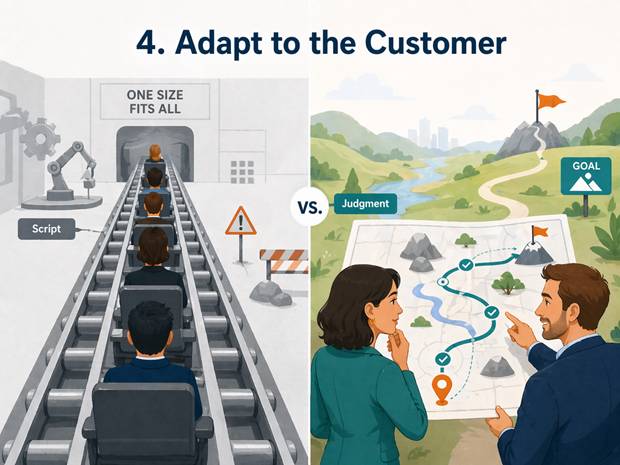
Scripts can help a salesperson begin. Adaptability helps a salesperson become useful.
| Trust-repair insight Scripts can help a salesperson begin. Adaptability helps a salesperson become useful. |
The fourth weakness in modern sales training is the excessive reliance on scripts, templates, talk tracks, formulas, and repeatable sequences.
Structure is useful. New salespeople need guidance. Teams need shared language. Organizations need consistency. But structure becomes a problem when it replaces judgment.
Customers can sense when a salesperson is following a formula. They notice when questions are asked mechanically. They notice when the response sounds rehearsed. They notice when the salesperson is trying to move them to the next stage instead of responding to what was actually said. That creates artificial professionalism. The salesperson sounds trained, but not necessarily trustworthy.
Adaptability does not mean selling without a process. It means using the process intelligently.
Two customers may be interested in the same product but need completely different conversations. One may need technical proof. Another may need financial justification. Another may need reassurance about implementation. Another may need help building internal support. Another may need the salesperson to slow down and explain the risks of doing nothing.
For example, a salesperson selling analytics software may meet one customer who already understands the technical value but needs help justifying the purchase to finance. Another customer may have budget but lacks reliable data. A third may have executive interest but weak operational readiness. The same product may be involved, but the sales conversation should not be the same.
This is why sales training must develop judgment, not just technique.
5. From Blame Shifting to Courageous Accountability
Agile Sales Value: Courageous introspection and personal accountability over assigning blame
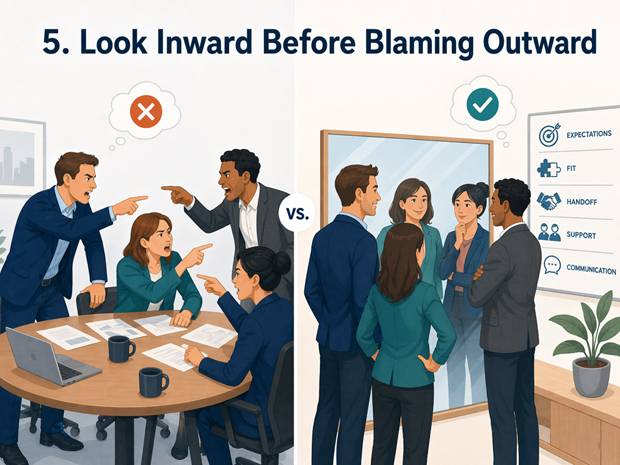
A sales culture that learns from disappointment becomes more credible over time.
| Trust-repair insight A sales culture that learns from disappointment becomes more credible over time. |
The fifth weakness in modern sales training is that it often does not teach enough accountability.
Salespeople are usually trained for what happens before the sale: prospecting, discovery, presentation, objection handling, negotiation, and closing. They are trained to manage the pipeline, advance opportunities, and hit targets. But they are not always trained to examine their role when the customer experience goes wrong.
When a customer is disappointed, organizations often blame the customer for poor adoption, the service team for weak support, the product team for missing features, or the market for changing conditions. Sometimes those explanations may contain truth. But they should not become excuses. Sales must also look at itself.
This value asks salespeople and sales leaders to examine uncomfortable issues through a professional lens. Was the customer properly understood? Were expectations realistic? Were limitations explained? Was the implementation effort made clear? Were the right stakeholders involved? Was the deal a good fit, or was it forced because the number mattered?
For example, if a customer fails to get value from a platform, the sales team should not immediately conclude that the customer did not use it properly. The team should examine whether it assessed readiness, explained the work required, involved the right decision-makers, and clarified what success would demand from the customer’s side.
This kind of accountability is not weakness. It is how sales becomes more professional. A sales culture that cannot examine itself will keep repeating the same trust failures.
6. From Hidden Limitations to Radical Clarity
Agile Sales Value: Transparency over secrecy
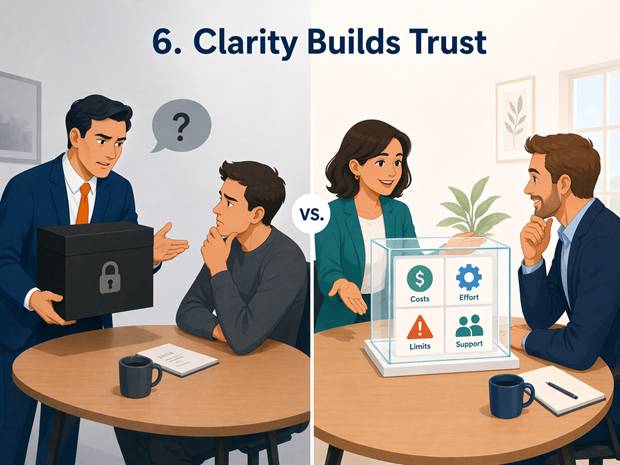
Transparency is not the enemy of selling. In a low-trust market, transparency is one of the strongest forms of selling.
| Trust-repair insight Transparency is not the enemy of selling. In a low-trust market, transparency is one of the strongest forms of selling. |
The sixth weakness in modern sales training is that transparency is often treated as a risk.
Salespeople may avoid discussing limitations because they worry it will weaken the deal. They may delay difficult details until later in the process. They may simplify implementation challenges. They may avoid talking about hidden costs, service constraints, required customer effort, or tradeoffs.
This may help a deal move forward in the short term, but it creates problems later. Customers do not lose trust because a product has limitations. Every product has limitations. Customers lose trust when those limitations are hidden, minimized, or revealed too late.
Transparency does not mean overwhelming the customer with every possible detail. It means giving the customer the information needed to make a clear and responsible decision.
A transparent salesperson explains what the solution does well, where it is weaker, what implementation requires, what is included, what may cost more later, what support is available, and what tradeoffs should be considered.
For example, a consulting firm selling a business transformation project should not imply that the outside consultant alone can produce the result. A transparent salesperson explains that success also depends on leadership commitment, employee participation, internal communication, access to data, and the customer’s willingness to make decisions.
That honesty may make the sale more complex, but it makes the relationship more real.
The Strongest Objection: Salespeople Still Need to Sell
A reasonable objection is that salespeople cannot simply become advisors who avoid persuasion. Businesses need revenue. Salespeople need to guide decisions. Customers sometimes delay unnecessarily, misunderstand value, or avoid action even when change is necessary.
That objection is valid. Agile Sales does not mean passive selling. It does not mean avoiding the close. It does not mean letting customers wander endlessly through uncertainty. It does not replace business development with polite conversation.
Good sales still requires confidence, structure, timing, and the ability to help a customer move toward a decision. The difference is that Agile Sales places persuasion inside a value-creation discipline.
The salesperson can still challenge the customer, but the challenge must serve the customer’s outcome. The salesperson can still ask for commitment, but the commitment should follow from clear value. The salesperson can still guide the decision, but the guidance should be transparent, evidence-based, and connected to the customer’s real situation.
In other words, Agile Sales does not weaken selling. It professionalizes it.
The Agile Sales Manifesto as a Trust Repair Model
The six values of the Agile Sales Manifesto respond directly to the weaknesses of modern sales training.
| Weakness in Modern Sales Training | Agile Sales Manifesto Correction |
| Salespeople are trained to lead with the pitch | Customer needs over “rinse and repeat” pitch process |
| Salespeople are trained to push for the close too early | Always creating value over “Always Be Closing” |
| Salespeople are trained to win the contract, not always to protect delivery | Cross-functional and iterative engagement with customers over contract negotiation |
| Salespeople are trained to follow scripts instead of using judgment | Adaptability over prescriptiveness |
| Sales cultures often blame customers, service, or product when outcomes fail | Courageous introspection and personal accountability over assigning blame |
| Salespeople are encouraged to hide limitations until later | Transparency over secrecy |
What Better Sales Training Should Teach
Better sales training should still teach communication, discovery, negotiation, follow-up, and closing. Those skills matter. But they should be taught inside a stronger professional frame.
- Understand a customer’s situation before recommending a solution.
- Interpret objections instead of defeating them.
- Explain tradeoffs honestly.
- Recognize a bad-fit sale before it becomes a trust problem.
- Collaborate with other departments before making promises.
- Follow up in ways that create value rather than noise.
- Remain accountable after the sale.
| Key principle Trust is not a soft outcome. Trust is a business asset. When customers trust a salesperson, they share better information, discuss risks more openly, consider recommendations more seriously, return more often, and refer more confidently. |
The Future of Sales Training Is Trust-Based
What is wrong with much of modern sales training is not that it teaches salespeople to sell. Selling is necessary. The problem is that it often teaches selling as a process of managing the customer rather than helping the customer make a better decision.
Customers lose trust when they feel pushed, processed, scripted, or manipulated. They gain trust when they feel understood, respected, informed, and supported.
The Agile Sales Manifesto helps because it gives sales training a better foundation. It shifts the focus from pitch to need, from closing to value, from contract to collaboration, from script to adaptability, from blame to accountability, and from secrecy to transparency.
This is not a softer version of sales, it is a more mature version of sales.
Agile Sales Training: Six Trust-Repair Values
PDF Agile Sales Training