Building Trust, Pricing Power, and Revenue That Lasts
Sales executives are under constant pressure to grow revenue, protect margins, motivate teams, satisfy customers, and respond to changing market conditions. In that environment, it is understandable that many organizations focus heavily on activity, pipeline, speed, and quarterly targets.
Those things matter. But they are not enough.
The strongest sales organizations are beginning to understand that sustainable performance depends on more than closing transactions. It depends on trust, customer value, professional judgment, better qualification, stronger collaboration, and revenue that remains healthy over time.
This is where Agile Sales becomes strategically important.
Agile Sales is not about making sales less accountable. It is not about slowing down performance. It is not about replacing ambition with process. It is about helping sales organizations become more adaptive, customer-centered, disciplined, and commercially resilient.
For sales executives, the central question is simple: Are we building a sales organization that creates long-term business value, or are we only chasing short-term transactions?
1. Trust Is Now a Business Advantage
Executive question: Are we building customer trust, or simply closing transactions?
Common objection: “Trust is important, but we can’t slow down the sales process.”
Strategic response: “Trust does not slow sales down. Lack of trust does. Customers move faster when they feel confident in the relationship.”
Customers remember more than what they purchased. They remember how they were treated, whether expectations were clear, whether promises were realistic, and whether the organization helped them make a confident decision.
Trust affects retention, referrals, reputation, renewal quality, and the long-term health of customer relationships. It also affects the speed of the sales process. Customers who feel uncertain, pressured, or confused usually slow down. They ask more defensive questions. They compare alternatives more aggressively. They delay decisions because they are not fully confident.
Trust is not a soft concept. It is operational. It improves communication, reduces resistance, and creates the conditions for more honest conversations. When customers trust the salesperson and the organization, they are more willing to discuss risks, priorities, objections, expectations, and decision criteria.
That makes the sales process clearer, not weaker.
A transaction may create revenue once. Trust creates relationships that continue generating value over time.
Key message: Trust builds confidence. Confidence drives results.
2. Customer Value Strengthens Pricing Power
Executive question: Are customers choosing us only because of price, or because they genuinely value working with us?
Common objection: “We’re in a highly competitive market. We can’t afford to lose deals on price.”
Strategic response: “The stronger the value and trust, the less dependent the organization becomes on discounting.”
In competitive markets, price pressure is real. Executives cannot ignore it. Procurement teams compare options. Competitors discount. Buyers look for leverage.
However, when a company competes mainly on price, it risks weakening its own position. Margins shrink. Differentiation becomes harder to defend. Customers become more transactional. Sales teams become conditioned to solve uncertainty with discounts instead of value.
Customers do not evaluate price in isolation. They also evaluate reliability, responsiveness, expertise, implementation quality, strategic relevance, risk reduction, and relationship quality.
Strong customer value strengthens pricing power because customers are not simply buying a product or service. They are buying confidence that the organization can help them achieve meaningful outcomes.
The goal is not to pretend price does not matter. It does. The goal is to make price one part of a larger value conversation rather than the only reason a customer chooses the company.
Customers may initially compare prices. But they stay because of value.
Key message: Create value. Reduce price sensitivity.
3. Strong Leaders Build Revenue That Lasts
Executive question: Are we building revenue that lasts, or revenue that creates future problems?
Common objection: “Right now, we need growth, not perfection.”
Strategic response: “Agile Sales is not about perfection. It is about reducing the kind of growth that creates churn, rework, and instability later.”
Not all revenue strengthens the organization equally.
Some revenue looks attractive at the beginning but becomes costly later. Poor-fit customers, unrealistic expectations, rushed qualification, weak onboarding, and overselling can create churn, dissatisfaction, support overload, implementation problems, forecasting instability, and internal friction.
This is the difference between fragile growth and healthy growth. Fragile growth often comes from discount-driven decisions, weak qualification, aggressive promises, or prioritizing volume over customer fit.
Healthy growth comes from the right customers, clear expectations, real value creation, strong onboarding, lasting relationships, and predictable results.
Strong executives understand that revenue quality matters as much as revenue quantity. A deal is not truly successful if it creates preventable problems for delivery teams, damages customer trust, or weakens long-term profitability.
Growth should not only look good in the current quarter. It should strengthen the business over time.
Key message: Focus on the right growth. Build revenue that lasts.
4. Agile Sales Makes Performance More Professional
Executive question: Are we helping sales teams become more professional, or simply pushing them harder?
Common objection: “Our salespeople already work hard.”
Strategic response: “Agile Sales helps hard work become more focused, more strategic, and more valuable to the customer.”
Many sales organizations already work hard. They make calls, send emails, follow up, manage pipeline, attend meetings, and pursue targets. The question is not only whether sales teams are busy.
High activity does not automatically create high value. A team can be extremely active and still struggle with weak discovery, poor qualification, repetitive outreach, scripted conversations, unclear value propositions, and transactional selling behaviours.
Agile Sales encourages salespeople to think more carefully about customer needs, business impact, qualification quality, communication effectiveness, and long-term relationship development.
It helps shift the sales conversation from “How do we close this?” to “How do we create enough value and confidence for the right customer to move forward?” That is a more professional standard.
The goal is not to reduce accountability. The goal is to improve the quality of sales judgment. Professional sales organizations do more than push harder. They listen better, diagnose better, communicate better, adapt better, and create more value.
Key message: Better conversations. Better results.
5. Incentives Shape the Culture Executives Actually Get
Executive question: Are our incentives aligned with the culture we claim to value?
Common objection: “If we reduce pressure, performance will drop.”
Strategic response: “Agile Sales does not remove accountability. It aligns accountability with healthier long-term outcomes.”
Executives often speak about customer value, collaboration, professionalism, long-term relationships, and sustainable growth. But employees pay close attention to what leadership rewards.
Organizations eventually become reflections of their measurement systems. If incentives reward only speed, volume, aggressive closing, and short-term activity, those behaviours will shape the customer experience, internal collaboration, and long-term priorities.
This does not mean employees are acting in bad faith. It means they are responding logically to the system around them.
Strong organizations still measure performance. They still care about revenue. They still expect discipline. But they also reward behaviours that support customer value, collaboration, long-term impact, retention, and sustainable growth.
If leaders say they value trust but reward only aggressive closing, the reward system wins. If leaders say they value collaboration but measure only individual short-term output, the measurement system wins.
Culture is not only taught. Culture is rewarded.
Key message: Align incentives. Drive the right behaviour.
6. Agile Sales Does Not Require a Massive Rollout
Executive question: Are we avoiding meaningful improvement because we assume change must be large, slow, and disruptive?
Common objection: “We don’t have time for another initiative right now.”
Strategic response: “Agile Sales delivers early wins through small, focused changes. You do not need a big rollout to see results. You need a better first step.”
Many executives hesitate to introduce Agile Sales because they assume it requires a large transformation project. This assumption often creates unnecessary resistance. Leaders already face sales targets, operational pressure, staffing challenges, implementation demands, and competing priorities. The idea of “another initiative” can feel exhausting.
Agile Sales works best when organizations begin with manageable improvements. That might mean improving qualification criteria, strengthening discovery questions, creating better feedback loops between sales and service, improving onboarding handoffs, or identifying one bottleneck that slows customer progress.
The point is not to transform everything at once. The point is to focus on one meaningful improvement, test it, learn from it, and scale what works.
Sustainable transformation rarely begins with a massive rollout. It begins with a better first step.
Key message: Start small. Win early. Scale smart.
7. Agile Sales Adapts to Different Industries
Executive question: Are we rejecting adaptable principles because we assume our industry is too unique?
Common objection: “What works for other companies may not apply to us.”
Strategic response: “Agile Sales is not one-size-fits-all. It adapts to the organization’s market, customers, and go-to-market model.”
Some executives believe Agile Sales will not apply to their organization because their industry is too technical, too regulated, too complex, or too different. That concern deserves respect. Industries do differ. Buying cycles, customer expectations, compliance requirements, competitive pressures, and operational realities vary significantly.
Agile Sales is not a rigid script. It is not about copying another company’s sales process. It is a flexible framework built around customer understanding, value creation, adaptability, communication, and continuous improvement.
A manufacturing company, technology firm, consulting business, healthcare organization, or financial services company may all sell differently. But they still depend on trust, communication, customer understanding, adaptation, and value creation.
The context changes. The principles remain useful.
Key message: Context may be different. Principles drive results.
8. Agile Sales Is an Investment, Not Just a Cost
Executive question: Are we viewing Agile Sales as a cost, or as an investment in stronger business performance?
Common objection: “It’s not in our budget this year.”
Strategic response: “Agile Sales is an investment that can reduce waste, improve win rates, and increase customer lifetime value.”
Budget concerns are understandable. Executives must make careful choices about where to allocate resources. But many organizations evaluate Agile Sales too narrowly, as if it were only a training expense.
The more important issue is the cost of poor sales alignment. Organizations already spend time, money, and energy dealing with lost opportunities, churn, weak onboarding, customer confusion, support escalation, discount dependency, poor-fit customers, and internal friction between sales, delivery, service, and leadership.
These costs are real, even when they are not always visible on a single budget line.
The real question is not only: “What does Agile Sales cost?” The stronger question is: “What is the organization already losing because these problems remain unresolved?”
Agile Sales should not be treated only as a sales training initiative. It should be evaluated as a business performance investment.
Key message: Smart investment today. Stronger results tomorrow.
9. Failed Agile Attempts Do Not Define Future Success
Executive question: Are we treating Agile as a temporary initiative, or as a long-term organizational capability?
Common objection: “We tried Agile in the past, and it didn’t last.”
Strategic response: “Past attempts do not automatically define future success. Agile Sales works when it is connected to leadership alignment, reinforcement, customer value, and real behaviour change.”
Many executives have seen Agile initiatives fail to stick. They may have experienced temporary enthusiasm, new terminology, additional meetings, or short-term experimentation without meaningful behavioural change. That skepticism is reasonable.
Often, the problem is not Agile itself. The problem is how it was introduced, reinforced, measured, and connected to leadership behaviour.
Agile fails when it becomes a workshop, a vocabulary exercise, or a temporary management trend. It fails when leadership does not reinforce the behaviours required to make it real.
The goal is not simply to “implement Agile.” The goal is to build organizational capabilities that improve how people communicate, solve problems, collaborate, adapt, and create customer value over time.
Real transformation does not happen because of one workshop or one framework rollout. It happens when leadership consistently reinforces the right behaviours, incentives, conversations, and priorities.
Key message: Past attempts do not define future success. This time, make it stick.
10. Leadership Buy-In Is Earned Through Demonstrated Value
Executive question: Are we expecting leadership support before demonstrating meaningful business value?
Common objection: “We don’t have leadership buy-in for another initiative.”
Strategic response: “Agile Sales builds leadership buy-in by focusing on real business outcomes, quick wins, and measurable impact.”
Many organizations struggle with change fatigue. Leaders are cautious because they have seen initiatives create disruption without producing meaningful outcomes.
Leadership resistance is often misunderstood. In many cases, leaders are not opposed to improvement. They resist unclear value, vague transformation language, long timelines, excessive complexity, and initiatives that fail to produce visible results.
Leadership support grows when transformation is connected to visible business value. That means improving conversations, strengthening alignment, reducing friction, increasing customer confidence, improving forecasting, reducing waste, and showing measurable progress.
Executives are more likely to support change when they can see that it improves performance rather than distracts from it. Transformation does not succeed through slogans. It succeeds when leadership sees meaningful results.
Key message: Leadership buy-in is earned through demonstrated value.
11. Teams Do Not Need to Be Agile Before They Begin
Executive question: Are we expecting teams to already possess Agile capabilities before giving them the opportunity to develop them?
Common objection: “Our team lacks Agile experience and expertise.”
Strategic response: “Agile Sales is designed for teams at any starting point. The goal is to meet the team where it is, build skills step by step, and deliver early wins along the way.”
Some executives hesitate because they believe their teams do not yet have the skills, mindset, or experience required for Agile Sales.
Agile Sales is not designed only for expert Agile teams. It helps teams build stronger communication, collaboration, adaptability, customer understanding, and decision-making capabilities over time.
Strong Agile capability is built gradually through practical training, coaching, tools, frameworks, real-world practice, leadership support, and continuous improvement.
Teams do not need to be perfectly Agile before they begin. They need a practical path, clear guidance, and opportunities to build confidence through experience.
Every expert was once a beginner. Progress matters more than perfection.
Key message: You do not need to be Agile today. You need a practical path to get there.
12. Being Too Busy Is Often a Sign the System Needs Improvement
Executive question: Are we staying trapped in inefficient systems because we are too busy to improve them?
Common objection: “We’re too busy to take on this kind of initiative right now.”
Strategic response: “Agile Sales saves time by eliminating waste, improving focus, and accelerating learning. Start small, create quick wins, and build momentum.”
One of the most common executive objections is: “We’re too busy right now.” This is understandable. Many organizations are stretched by sales pressure, customer expectations, staffing challenges, operational demands, and constant change.
When teams are overwhelmed, any new initiative can feel like an additional burden. But Agile Sales is not meant to create more unnecessary work. It is designed to reduce the inefficiencies that already consume time.
Organizations often lose time through poor qualification, unclear communication, avoidable rework, customer confusion, duplicated effort, weak handoffs, cross-functional friction, and reactive problem-solving.
This creates busyness without always creating proportional value.
The goal is not to pause operations for a massive transformation project. The goal is to create practical improvements that help the organization work more intelligently over time.
Many organizations are not busy simply because they work hard. They are busy because inefficient systems create unnecessary friction. Agile Sales helps build a better way of working that eventually gives time back.
Key message: You are busy because the old way is inefficient. Build a better way that gives time back.
Executive Case for Agile Sales
Agile Sales is not a softer version of sales.
It is a more disciplined, professional, adaptive, and customer-centered approach to building sustainable revenue.
It helps executives connect sales performance to trust, pricing power, customer fit, incentive design, leadership behaviour, and long-term account health.
This matters because sales performance is no longer only about how many deals are closed. It is also about whether those deals are healthy, whether customers stay, whether margins are protected, whether teams collaborate effectively, and whether the organization is building a reputation that strengthens future growth.
The strongest sales organizations understand that trust is not separate from performance. Value is not separate from pricing power. Culture is not separate from incentives. And agility is not separate from executive leadership.
The executive challenge is clear: Do we want a sales organization that only works harder, or one that works smarter, earns trust, creates value, and builds revenue that lasts?
Agile Sales provides a practical path forward. Start small. Win early. Scale smart. Build trust. Create value. Strengthen revenue quality. Lead a sales organization designed for sustainable growth.
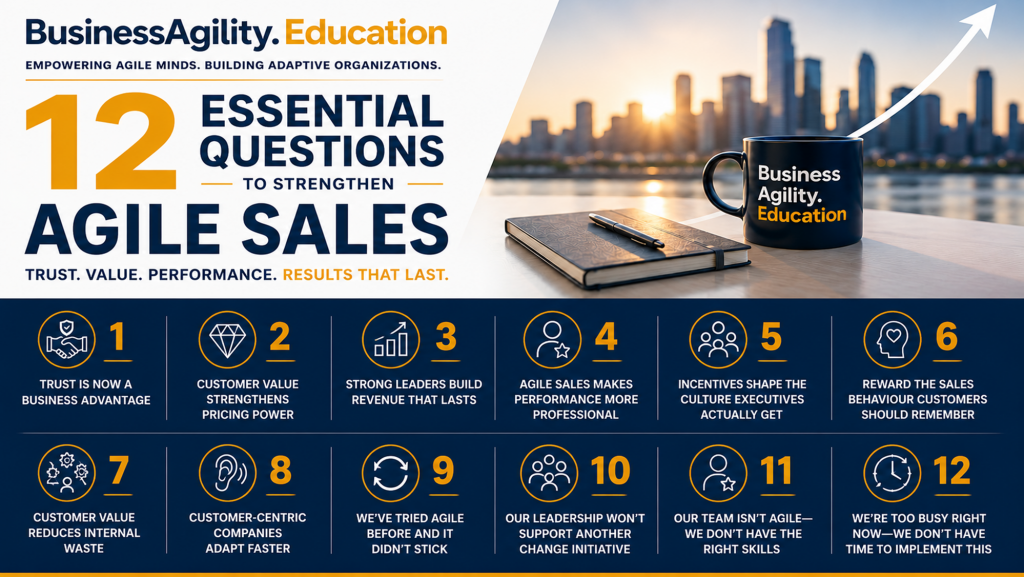
Summary of the 12 Agile Sales Questions for Sales Executives
| Theme | Executive Message |
| Trust Is Now a Business Advantage | Trust builds confidence. Confidence drives results. |
| Customer Value Strengthens Pricing Power | Create value. Reduce price sensitivity. |
| Strong Leaders Build Revenue That Lasts | Focus on the right growth. Build revenue that lasts. |
| Agile Sales Makes Performance More Professional | Better conversations. Better results. |
| Incentives Shape the Culture Executives Actually Get | Align incentives. Drive the right behaviour. |
| Agile Sales Does Not Require a Massive Rollout | Start small. Win early. Scale smart. |
| Agile Sales Adapts to Different Industries | Context may be different. Principles drive results. |
| Agile Sales Is an Investment, Not Just a Cost | Smart investment today. Stronger results tomorrow. |
| Failed Agile Attempts Do Not Define Future Success | Past attempts do not define future success. This time, make it stick. |
| Leadership Buy-In Is Earned Through Demonstrated Value | Leadership buy-in is earned through demonstrated value. |
| Teams Do Not Need to Be Agile Before They Begin | You do not need to be Agile today. You need a practical path to get there. |
| Being Too Busy Is Often a Sign the System Needs Improvement | You are busy because the old way is inefficient. Build a better way that gives time back. |
Read the Agile Sales Manifesto
We invite you to read the Agile Sales Manifesto and Agile Sales Training!